what mass m must be hung from this end of the string to produce one loop of a standing wave?
16 Waves
xvi.vi Standing Waves and Resonance
Learning Objectives
By the stop of this section, you will be able to:
- Draw standing waves and explain how they are produced
- Describe the modes of a standing wave on a string
- Provide examples of continuing waves beyond the waves on a string
Throughout this chapter, nosotros have been studying traveling waves, or waves that transport energy from one identify to some other. Under certain weather condition, waves can bounce dorsum and forth through a item region, finer becoming stationary. These are chosen continuing waves.
Another related effect is known every bit resonance. In Oscillations, nosotros defined resonance equally a phenomenon in which a small-amplitude driving force could produce large-aamplitude motion. Recall of a kid on a swing, which can exist modeled every bit a concrete pendulum. Relatively small-aamplitude pushes by a parent can produce big-aamplitude swings. Sometimes this resonance is adept—for case, when producing music with a stringed musical instrument. At other times, the effects tin can exist devastating, such as the collapse of a building during an earthquake. In the instance of standing waves, the relatively big amplitude standing waves are produced by the superposition of smaller amplitude component waves.
Standing Waves
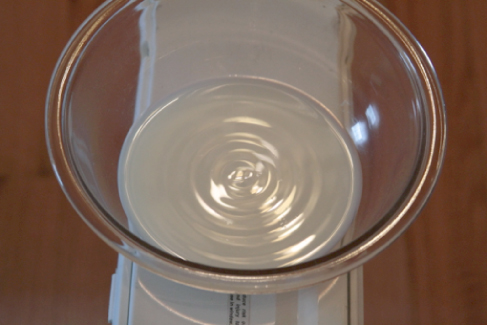
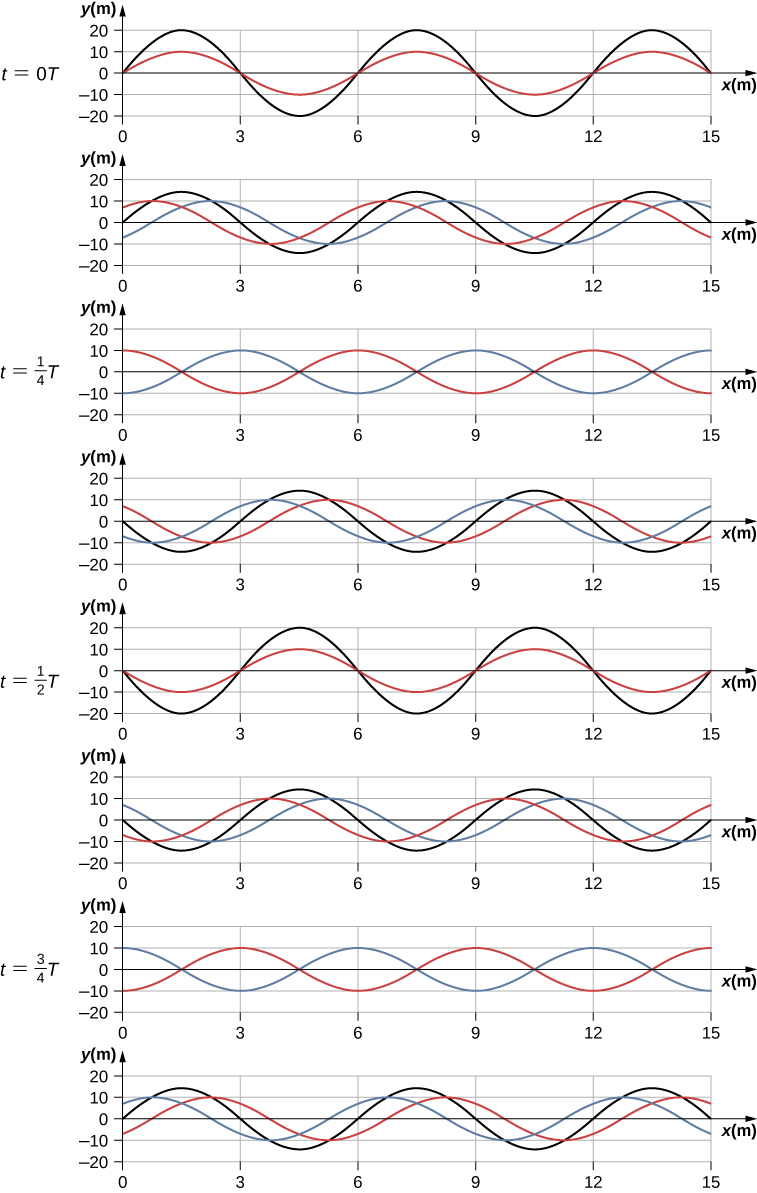
Sometimes waves practice non seem to move; rather, they just vibrate in place. You can run into unmoving waves on the surface of a glass of milk in a fridge, for example. Vibrations from the refrigerator motor create waves on the milk that oscillate up and downwards but practice not seem to motion across the surface. (Figure) shows an experiment you can attempt at home. Take a bowl of milk and identify it on a common box fan. Vibrations from the fan will produce round standing waves in the milk. The waves are visible in the photo due to the reflection from a lamp. These waves are formed by the superposition of two or more traveling waves, such every bit illustrated in (Figure) for ii identical waves moving in contrary directions. The waves move through each other with their disturbances adding as they go by. If the two waves have the same amplitude and wavelength, then they alternate between constructive and subversive interference. The resultant looks like a moving ridge standing in place and, thus, is called a standing moving ridge.
![\[x=0\,\text{m},3\,\text{m},6\,\text{m},9\,\text{m},12\,\text{m},15\,\text{m}\]](https://opentextbc.ca/universityphysicsv1openstax/wp-content/ql-cache/quicklatex.com-86cacc3feae3e62963c6ced03f256934_l3.png "Rendered by QuickLaTeX.com")
and notice that the resultant wave always equals zero at these points, no matter what the time is. These points are known as stock-still points (nodes). In between each two nodes is an antinode, a place where the medium oscillates with an aamplitude equal to the sum of the amplitudes of the private waves.
Consider two identical waves that move in opposite directions. The showtime moving ridge has a moving ridge function of
![\[{y}_{1}(x,t)=A\,\text{sin}(kx-\omega t)\]](https://opentextbc.ca/universityphysicsv1openstax/wp-content/ql-cache/quicklatex.com-33fb9a209b3191d0ff450c7e7651e47e_l3.png "Rendered by QuickLaTeX.com")
and the 2nd wave has a moving ridge function
![\[{y}_{2}(x,t)=A\,\text{sin}(kx+\omega t)\]](https://opentextbc.ca/universityphysicsv1openstax/wp-content/ql-cache/quicklatex.com-2dd1b2e46f77a46297271451f3f6e37b_l3.png "Rendered by QuickLaTeX.com")
. The waves interfere and grade a resultant moving ridge
![\[\begin{array}{c}y(x,t)={y}_{1}(x,t)+{y}_{2}(x,t),\hfill \\ y(x,t)=A\,\text{sin}(kx-\omega t)+A\,\text{sin}(kx+\omega t).\hfill \end{array}\]](https://opentextbc.ca/universityphysicsv1openstax/wp-content/ql-cache/quicklatex.com-a8fcb6c4951de12c87871eb5e0e792ce_l3.png "Rendered by QuickLaTeX.com")
This tin be simplified using the trigonometric identity
![\[\text{sin}(\alpha ±\beta )=\text{sin}\,\alpha \,\text{cos}\,\beta ±\text{cos}\,\alpha \,\text{sin}\,\beta ,\]](https://opentextbc.ca/universityphysicsv1openstax/wp-content/ql-cache/quicklatex.com-9936f09c910f8d8cbb3c92e5afdb5d51_l3.png "Rendered by QuickLaTeX.com")
where
![\[\alpha =kx\]](https://opentextbc.ca/universityphysicsv1openstax/wp-content/ql-cache/quicklatex.com-1aac74dd6e663402ba4b7386d9db574e_l3.png "Rendered by QuickLaTeX.com")
and
![\[\beta =\omega t\]](https://opentextbc.ca/universityphysicsv1openstax/wp-content/ql-cache/quicklatex.com-e701d09b766a0905240a06837aca802d_l3.png "Rendered by QuickLaTeX.com")
, giving the states
![\[y(x,t)=A[\text{sin}(kx)\text{cos}(\omega t)-\text{cos}(kx)\text{sin}(\omega t)+\text{sin}(kx)\text{cos}(\omega t)-\text{cos}(kx)\text{sin}(\omega t)],\]](https://opentextbc.ca/universityphysicsv1openstax/wp-content/ql-cache/quicklatex.com-f4abe61a983ab33ed7bcaf7ed7f8d14f_l3.png "Rendered by QuickLaTeX.com")
which simplifies to
![\[y(x,t)=[2A\,\text{sin}(kx)]\text{cos}(\omega t).\]](https://opentextbc.ca/universityphysicsv1openstax/wp-content/ql-cache/quicklatex.com-406cc954a5f2a3a344ff53cdfc0fb6b8_l3.png "Rendered by QuickLaTeX.com")
Notice that the resultant wave is a sine wave that is a office only of position, multiplied past a cosine role that is a role merely of time. Graphs of y(ten,t) every bit a function of ten for various times are shown in (Effigy). The cerise moving ridge moves in the negative x-management, the blue wave moves in the positive ten-direction, and the black moving ridge is the sum of the 2 waves. As the red and blue waves move through each other, they move in and out of constructive interference and destructive interference.
Initially, at time
![\[t=0,\]](https://opentextbc.ca/universityphysicsv1openstax/wp-content/ql-cache/quicklatex.com-46c401e0361029a2fbdc86d446443cf4_l3.png "Rendered by QuickLaTeX.com")
the two waves are in phase, and the effect is a wave that is twice the amplitude of the private waves. The waves are also in phase at the fourth dimension
![\[t=\frac{T}{2}.\]](https://opentextbc.ca/universityphysicsv1openstax/wp-content/ql-cache/quicklatex.com-f853b4c91687735e445e422de554c3c3_l3.png "Rendered by QuickLaTeX.com")
In fact, the waves are in phase at any integer multiple of one-half of a period:
![\[t=n\frac{T}{2}\,\text{where}\,n=0,1,2,3\text{...}.\,\text{(in phase)}.\]](https://opentextbc.ca/universityphysicsv1openstax/wp-content/ql-cache/quicklatex.com-0bbfa6bd3860ea9d16be2cf2d99797a4_l3.png "Rendered by QuickLaTeX.com")
At other times, the 2 waves are
![\[180\text{°}(\pi \,\text{radians})\]](https://opentextbc.ca/universityphysicsv1openstax/wp-content/ql-cache/quicklatex.com-251e6e21509a47b859f803e524806c92_l3.png "Rendered by QuickLaTeX.com")
out of stage, and the resulting wave is equal to aught. This happens at
![\[t=\frac{1}{4}T,\frac{3}{4}T,\frac{5}{4}T\text{,...},\frac{n}{4}T\,\text{where}\,n=1,3,5\text{...}.\,\text{(out of phase)}.\]](https://opentextbc.ca/universityphysicsv1openstax/wp-content/ql-cache/quicklatex.com-d7612ff09cd3e557594f6fffa39cee60_l3.png "Rendered by QuickLaTeX.com")
Notice that some x-positions of the resultant wave are ever cipher no matter what the phase relationship is. These positions are called nodes. Where do the nodes occur? Consider the solution to the sum of the two waves
Finding the positions where the sine function equals goose egg provides the positions of the nodes.
![\[\begin{array}{ccc}\hfill \text{sin}(kx)& =\hfill & 0\hfill \\ \hfill kx& =\hfill & 0,\pi ,2\pi ,3\pi \text{,...}\hfill \\ \hfill \frac{2\pi }{\lambda }x& =\hfill & 0,\pi ,2\pi ,3\pi \text{,...}\hfill \\ \hfill x& =\hfill & 0,\frac{\lambda }{2},\lambda ,\frac{3\lambda }{2}\text{,...}=n\frac{\lambda }{2}\quad n=0,1,2,3\text{,...}.\hfill \end{array}\]](https://opentextbc.ca/universityphysicsv1openstax/wp-content/ql-cache/quicklatex.com-d70e41ba6926b13de20a8ebc812c0d95_l3.png "Rendered by QuickLaTeX.com")
At that place are also positions where y oscillates between
![\[y=\text{±}A\]](https://opentextbc.ca/universityphysicsv1openstax/wp-content/ql-cache/quicklatex.com-693d5b90394bc7e33f3aefc962ffcdab_l3.png "Rendered by QuickLaTeX.com")
. These are the antinodes. We can discover them by considering which values of x outcome in
![\[\text{sin}(kx)=\text{±}1\]](https://opentextbc.ca/universityphysicsv1openstax/wp-content/ql-cache/quicklatex.com-3c3cfde3c084512cb303eaa6f3eedd4a_l3.png "Rendered by QuickLaTeX.com")
.
![\[\begin{array}{ccc}\hfill \text{sin}(kx)& =\hfill & ±1\hfill \\ \hfill kx& =\hfill & \frac{\pi }{2},\frac{3\pi }{2},\frac{5\pi }{2}\text{,...}\hfill \\ \hfill \frac{2\pi }{\lambda }x& =\hfill & \frac{\pi }{2},\frac{3\pi }{2},\frac{5\pi }{2}\text{,...}\hfill \\ \hfill x& =\hfill & \frac{\lambda }{4},\frac{3\lambda }{4},\frac{5\lambda }{4}\text{,...}=n\frac{\lambda }{4}\quad n=1,3,5\text{,...}.\hfill \end{array}\]](https://opentextbc.ca/universityphysicsv1openstax/wp-content/ql-cache/quicklatex.com-f0f58975d20da3c8359b8e40813c44ba_l3.png "Rendered by QuickLaTeX.com")
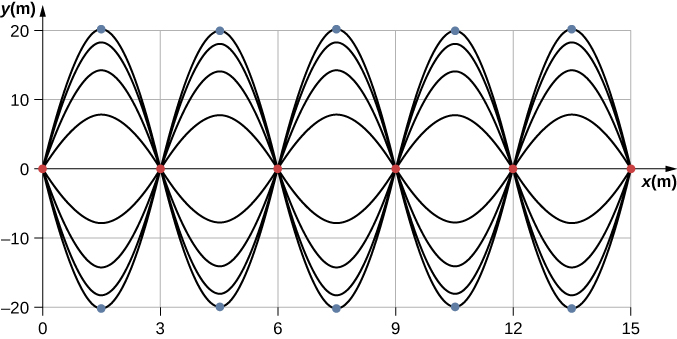
What results is a standing moving ridge equally shown in (Effigy), which shows snapshots of the resulting wave of two identical waves moving in reverse directions. The resulting wave appears to be a sine moving ridge with nodes at integer multiples of half wavelengths. The antinodes oscillate between
![\[y=\text{±}2A\]](https://opentextbc.ca/universityphysicsv1openstax/wp-content/ql-cache/quicklatex.com-4bdf06fd1867a9d0457e1faf555cca0b_l3.png "Rendered by QuickLaTeX.com")
due to the cosine term,
![\[\text{cos}(\omega t)\]](https://opentextbc.ca/universityphysicsv1openstax/wp-content/ql-cache/quicklatex.com-8a6d9f5e5d0accd8558962b44773dbf4_l3.png "Rendered by QuickLaTeX.com")
, which oscillates between
![\[±1\]](https://opentextbc.ca/universityphysicsv1openstax/wp-content/ql-cache/quicklatex.com-14e0e54d265e7e96455ce2e58211ee0f_l3.png "Rendered by QuickLaTeX.com")
.
The resultant wave appears to exist standing still, with no apparent movement in the 10-direction, although it is composed of one wave function moving in the positive, whereas the 2nd wave is moving in the negative x-direction. (Effigy) shows various snapshots of the resulting wave. The nodes are marked with red dots while the antinodes are marked with blue dots.
![\[y=\text{±}A.\]](https://opentextbc.ca/universityphysicsv1openstax/wp-content/ql-cache/quicklatex.com-027201acbdd8ed46f795c3fef54a7383_l3.png "Rendered by QuickLaTeX.com")
The nodes are marked with red dots and the antinodes are marked with blue dots.
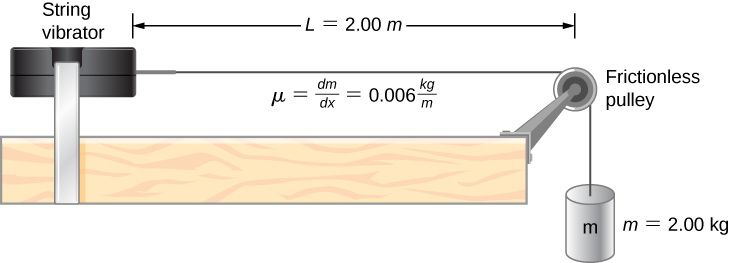
A common example of continuing waves are the waves produced by stringed musical instruments. When the cord is plucked, pulses travel along the string in opposite directions. The ends of the strings are fixed in place, so nodes announced at the ends of the strings—the boundary conditions of the system, regulating the resonant frequencies in the strings. The resonance produced on a string instrument can be modeled in a physics lab using the apparatus shown in (Figure).
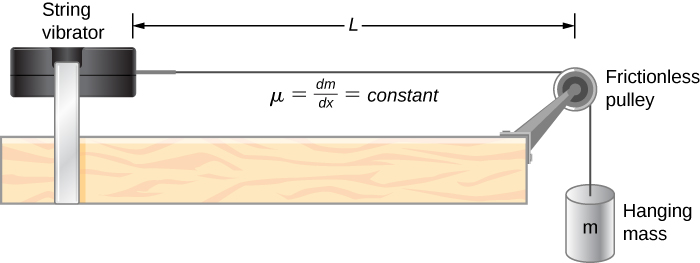
The lab setup shows a string attached to a cord vibrator, which oscillates the string with an adjustable frequency f. The other end of the string passes over a frictionless caster and is tied to a hanging mass. The magnitude of the tension in the string is equal to the weight of the hanging mass. The string has a constant linear density (mass per length)
![\[\mu\]](https://opentextbc.ca/universityphysicsv1openstax/wp-content/ql-cache/quicklatex.com-9f7df4b90354b704b140cdd22fc8905f_l3.png "Rendered by QuickLaTeX.com")
and the speed at which a wave travels down the cord equals
![\[v=\sqrt{\frac{{F}_{T}}{\mu }}=\sqrt{\frac{mg}{\mu }}\]](https://opentextbc.ca/universityphysicsv1openstax/wp-content/ql-cache/quicklatex.com-82767c3ae206f6b58882346488875796_l3.png "Rendered by QuickLaTeX.com")
(Figure). The symmetrical boundary conditions (a node at each end) dictate the possible frequencies that can excite standing waves. Starting from a frequency of nada and slowly increasing the frequency, the get-go style
![\[n=1\]](https://opentextbc.ca/universityphysicsv1openstax/wp-content/ql-cache/quicklatex.com-c0939d07529e5e8215cc42daa26c562d_l3.png "Rendered by QuickLaTeX.com")
appears as shown in (Effigy). The first mode, also chosen the fundamental fashion or the first harmonic, shows half of a wavelength has formed, and then the wavelength is equal to twice the length between the nodes
![\[{\lambda }_{1}=2L\]](https://opentextbc.ca/universityphysicsv1openstax/wp-content/ql-cache/quicklatex.com-5bf77088347b2acab66ef4ffd775a11d_l3.png "Rendered by QuickLaTeX.com")
. The key frequency, or first harmonic frequency, that drives this fashion is
![\[{f}_{1}=\frac{v}{{\lambda }_{1}}=\frac{v}{2L},\]](https://opentextbc.ca/universityphysicsv1openstax/wp-content/ql-cache/quicklatex.com-0ad40f0bf392b9f6cfe7e08d69666915_l3.png "Rendered by QuickLaTeX.com")
where the speed of the moving ridge is
![\[v=\sqrt{\frac{{F}_{T}}{\mu }}.\]](https://opentextbc.ca/universityphysicsv1openstax/wp-content/ql-cache/quicklatex.com-6db28056555e0253307163e1808ec0d0_l3.png "Rendered by QuickLaTeX.com")
Keeping the tension abiding and increasing the frequency leads to the second harmonic or the
![\[n=2\]](https://opentextbc.ca/universityphysicsv1openstax/wp-content/ql-cache/quicklatex.com-f0dd3c180c724eedff487c9931dd61b2_l3.png "Rendered by QuickLaTeX.com")
mode. This mode is a total wavelength
![\[{\lambda }_{2}=L\]](https://opentextbc.ca/universityphysicsv1openstax/wp-content/ql-cache/quicklatex.com-929b7a548253b3d3bf202b231f8b81fc_l3.png "Rendered by QuickLaTeX.com")
and the frequency is twice the fundamental frequency:
![\[{f}_{2}=\frac{v}{{\lambda }_{2}}=\frac{v}{L}=2{f}_{1}.\]](https://opentextbc.ca/universityphysicsv1openstax/wp-content/ql-cache/quicklatex.com-df8c7a5af50001000c78313aff8af73f_l3.png "Rendered by QuickLaTeX.com")
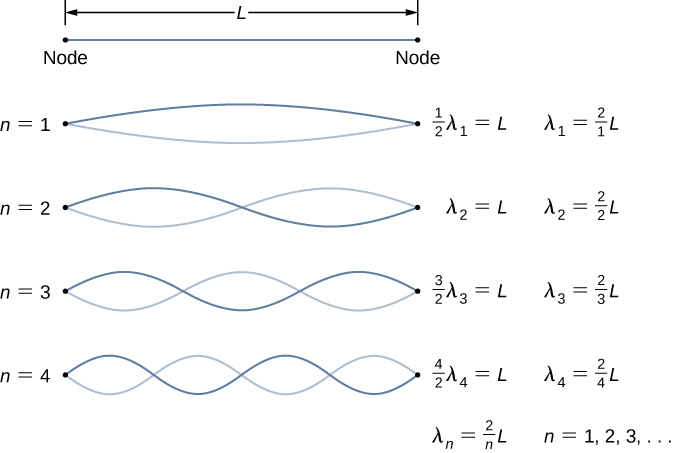
The next 2 modes, or the third and fourth harmonics, have wavelengths of
![\[{\lambda }_{3}=\frac{2}{3}L\]](https://opentextbc.ca/universityphysicsv1openstax/wp-content/ql-cache/quicklatex.com-5fd190af54a577c2729203e0244c418e_l3.png "Rendered by QuickLaTeX.com")
and
![\[{\lambda }_{4}=\frac{2}{4}L,\]](https://opentextbc.ca/universityphysicsv1openstax/wp-content/ql-cache/quicklatex.com-1b7f17550499c3ab7a0bb007823949c5_l3.png "Rendered by QuickLaTeX.com")
driven past frequencies of
![\[{f}_{3}=\frac{3v}{2L}=3{f}_{1}\]](https://opentextbc.ca/universityphysicsv1openstax/wp-content/ql-cache/quicklatex.com-9b08d08829bf2ec16e56a9f3d0eb1acb_l3.png "Rendered by QuickLaTeX.com")
and
![\[{f}_{4}=\frac{4v}{2L}=4{f}_{1}.\]](https://opentextbc.ca/universityphysicsv1openstax/wp-content/ql-cache/quicklatex.com-426811dd42cb23e94d6c24480f3a118b_l3.png "Rendered by QuickLaTeX.com")
All frequencies higher up the frequency
![\[{f}_{1}\]](https://opentextbc.ca/universityphysicsv1openstax/wp-content/ql-cache/quicklatex.com-d496d3275fca3dafcaf901dda175d564_l3.png "Rendered by QuickLaTeX.com")
are known as the overtones. The equations for the wavelength and the frequency tin be summarized as:
![\[{\lambda }_{n}=\frac{2}{n}L\quad n=1,2,3,4,5\text{...}\]](https://opentextbc.ca/universityphysicsv1openstax/wp-content/ql-cache/quicklatex.com-534eb62a68c88f4257f1d18e48989df7_l3.png "Rendered by QuickLaTeX.com")
![\[{f}_{n}=n\frac{v}{2L}=n{f}_{1}\quad n=1,2,3,4,5\text{...}\]](https://opentextbc.ca/universityphysicsv1openstax/wp-content/ql-cache/quicklatex.com-7b3574475fdf9caabf78b4f4623cbd46_l3.png "Rendered by QuickLaTeX.com")
The standing wave patterns that are possible for a string, the first four of which are shown in (Figure), are known as the normal modes, with frequencies known as the normal frequencies. In summary, the first frequency to produce a normal fashion is called the fundamental frequency (or kickoff harmonic). Any frequencies to a higher place the fundamental frequency are overtones. The 2d frequency of the
normal mode of the string is the first overtone (or second harmonic). The frequency of the
![\[n=3\]](https://opentextbc.ca/universityphysicsv1openstax/wp-content/ql-cache/quicklatex.com-8e1be461e62a5dda75974c7de6d5f1a1_l3.png "Rendered by QuickLaTeX.com")
normal style is the second overtone (or third harmonic) and then on.
The solutions shown every bit (Equation) and (Equation) are for a string with the boundary condition of a node on each end. When the boundary condition on either side is the aforementioned, the arrangement is said to accept symmetric boundary weather condition. (Equation) and (Equation) are proficient for any symmetric purlieus weather, that is, nodes at both ends or antinodes at both ends.
Case
Standing Waves on a String
Consider a string of
![\[L=2.00\,\text{m}.\]](https://opentextbc.ca/universityphysicsv1openstax/wp-content/ql-cache/quicklatex.com-e045b7c600ebb6ebcd21deb1fe9d664b_l3.png "Rendered by QuickLaTeX.com")
attached to an adaptable-frequency string vibrator equally shown in (Figure). The waves produced by the vibrator travel down the cord and are reflected by the fixed boundary condition at the pulley. The string, which has a linear mass density of
![\[\mu =0.006\,\text{kg/m,}\]](https://opentextbc.ca/universityphysicsv1openstax/wp-content/ql-cache/quicklatex.com-d31bbec40c6d982e62a0d985bbbbe8db_l3.png "Rendered by QuickLaTeX.com")
is passed over a frictionless caster of a negligible mass, and the tension is provided by a ii.00-kg hanging mass. (a) What is the velocity of the waves on the cord? (b) Draw a sketch of the start iii normal modes of the continuing waves that can exist produced on the string and label each with the wavelength. (c) List the frequencies that the string vibrator must exist tuned to in gild to produce the first three normal modes of the standing waves.
Strategy
- The velocity of the wave can be found using
The tension is provided past the weight of the hanging mass.
- The standing waves will depend on the boundary weather condition. In that location must be a node at each end. The first mode will be one half of a wave. The 2nd can be constitute past adding a one-half wavelength. That is the shortest length that will issue in a node at the boundaries. For example, adding one quarter of a wavelength will result in an antinode at the boundary and is non a style which would satisfy the boundary conditions. This is shown in (Effigy).
- Since the wave speed velocity is the wavelength times the frequency, the frequency is wave speed divided past the wavelength.

Effigy 16.31 (a) The effigy represents the second mode of the string that satisfies the purlieus conditions of a node at each cease of the string. (b)This figure could not perchance be a normal mode on the string because it does not satisfy the boundary conditions. There is a node on ane finish, only an antinode on the other.
Solution
- Begin with the velocity of a wave on a string. The tension is equal to the weight of the hanging mass. The linear mass density and mass of the hanging mass are given:
![\[v=\sqrt{\frac{{F}_{T}}{\mu }}=\sqrt{\frac{mg}{\mu }}=\sqrt{\frac{2\,\text{kg}(9.8\frac{\text{m}}{\text{s}})}{0.006\frac{\text{kg}}{\text{m}}}}=57.15\,\text{m/s}.\]](https://opentextbc.ca/universityphysicsv1openstax/wp-content/ql-cache/quicklatex.com-6559e350c9eda371540780d1d3746a7f_l3.png "Rendered by QuickLaTeX.com")
- The first normal mode that has a node on each end is a half wavelength. The side by side two modes are establish by calculation a half of a wavelength.

- The frequencies of the first 3 modes are found by using
![\[f=\frac{{v}_{w}}{\lambda }.\]](https://opentextbc.ca/universityphysicsv1openstax/wp-content/ql-cache/quicklatex.com-52e176c1f6da38d4601cd3b9786ae282_l3.png "Rendered by QuickLaTeX.com")
![\[\begin{array}{}\\ {f}_{1}=\frac{{v}_{w}}{{\lambda }_{1}}=\frac{57.15\,\text{m/s}}{4.00\,\text{m}}=14.29\,\text{Hz}\hfill \\ {f}_{2}=\frac{{v}_{w}}{{\lambda }_{2}}=\frac{57.15\,\text{m/s}}{2.00\,\text{m}}=28.58\,\text{Hz}\hfill \\ {f}_{3}=\frac{{v}_{w}}{{\lambda }_{3}}=\frac{57.15\,\text{m/s}}{1.333\,\text{m}}=42.87\,\text{Hz}\hfill \end{array}\]](https://opentextbc.ca/universityphysicsv1openstax/wp-content/ql-cache/quicklatex.com-229b14a746f254fce2e112a60fa0b0c6_l3.png "Rendered by QuickLaTeX.com")
Significance
The 3 continuing modes in this example were produced by maintaining the tension in the string and adjusting the driving frequency. Keeping the tension in the string constant results in a constant velocity. The aforementioned modes could have been produced past keeping the frequency constant and adjusting the speed of the wave in the string (by irresolute the hanging mass.)
Visit this simulation to play with a 1D or 2D arrangement of coupled mass-spring oscillators. Vary the number of masses, set the initial weather, and watch the system evolve. See the spectrum of normal modes for arbitrary motion. Run across longitudinal or transverse modes in the 1D system.
Check Your Understanding
The equations for the wavelengths and the frequencies of the modes of a moving ridge produced on a cord:
![\[\begin{array}{}\\ {\lambda }_{n}=\frac{2}{n}L\quad n=1,2,3,4,5\text{...}\,\text{and}\hfill \\ {f}_{n}=n\frac{v}{2L}=n{f}_{1}\quad n=1,2,3,4,5\text{...}\hfill \end{array}\]](https://opentextbc.ca/universityphysicsv1openstax/wp-content/ql-cache/quicklatex.com-738d7ac2d2ab4a8dd881e7440722b05b_l3.png "Rendered by QuickLaTeX.com")
were derived past considering a wave on a string where there were symmetric boundary weather of a node at each stop. These modes resulted from two sinusoidal waves with identical characteristics except they were moving in reverse directions, bars to a region 50 with nodes required at both ends. Will the same equations work if there were symmetric boundary conditions with antinodes at each end? What would the normal modes look similar for a medium that was free to oscillate on each end? Don't worry for now if you cannot imagine such a medium, just consider two sinusoidal moving ridge functions in a region of length Fifty, with antinodes on each end.
Yes, the equations would work equally well for symmetric boundary atmospheric condition of a medium free to oscillate on each cease where there was an antinode on each end. The normal modes of the start iii modes are shown below. The dotted line shows the equilibrium position of the medium.

Note that the starting time mode is 2 quarters, or ane half, of a wavelength. The second mode is one quarter of a wavelength, followed past 1 half of a wavelength, followed past 1 quarter of a wavelength, or one full wavelength. The tertiary way is 1 and a half wavelengths. These are the same result equally the string with a node on each cease. The equations for symmetrical boundary weather condition piece of work equally well for fixed boundary conditions and gratuitous boundary conditions. These results will be revisited in the next chapter when discussing audio moving ridge in an open tube.
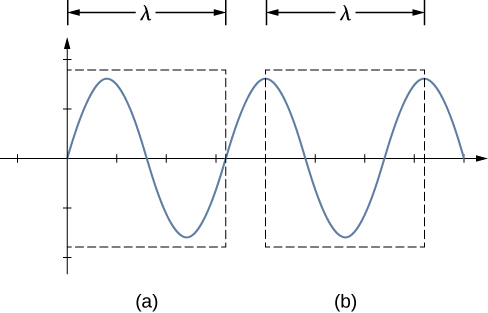
The gratuitous boundary conditions shown in the last Check Your Understanding may seem hard to visualize. How can there exist a system that is complimentary to oscillate on each terminate? In (Figure) are shown 2 possible configuration of a metallic rods (shown in scarlet) attached to two supports (shown in blue). In part (a), the rod is supported at the ends, and in that location are stock-still purlieus weather condition at both ends. Given the proper frequency, the rod can be driven into resonance with a wavelength equal to length of the rod, with nodes at each terminate. In part (b), the rod is supported at positions i quarter of the length from each end of the rod, and there are complimentary boundary conditions at both ends. Given the proper frequency, this rod can also be driven into resonance with a wavelength equal to the length of the rod, but in that location are antinodes at each end. If you are having trouble visualizing the wavelength in this figure, remember that the wavelength may be measured betwixt any two nearest identical points and consider (Figure).
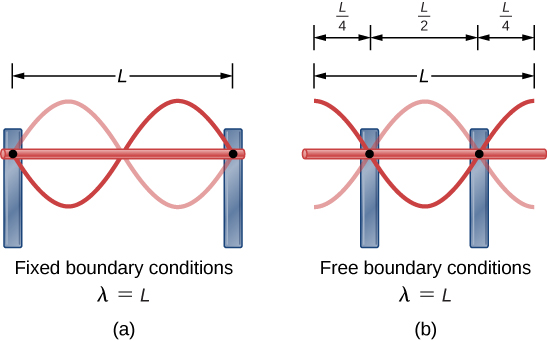
Note that the study of continuing waves can go quite complex. In (Figure)(a), the
style of the standing moving ridge is shown, and it results in a wavelength equal to L. In this configuration, the
mode would also have been possible with a standing wave equal to 250. Is it possible to become the
fashion for the configuration shown in part (b)? The respond is no. In this configuration, there are additional conditions set across the boundary conditions. Since the rod is mounted at a point one quarter of the length from each side, a node must exist there, and this limits the possible modes of standing waves that can be created. We leave it equally an exercise for the reader to consider if other modes of continuing waves are possible. It should exist noted that when a arrangement is driven at a frequency that does not cause the system to resonate, vibrations may all the same occur, just the amplitude of the vibrations will be much smaller than the amplitude at resonance.
A field of mechanical engineering science uses the audio produced by the vibrating parts of complex mechanical systems to troubleshoot problems with the systems. Suppose a part in an machine is resonating at the frequency of the car's engine, causing unwanted vibrations in the automobile. This may crusade the engine to fail prematurely. The engineers employ microphones to tape the sound produced by the engine, then use a technique chosen Fourier analysis to find frequencies of sound produced with large amplitudes so look at the parts listing of the automobile to find a function that would resonate at that frequency. The solution may be equally simple as changing the limerick of the material used or changing the length of the role in question.
There are other numerous examples of resonance in standing waves in the concrete earth. The air in a tube, such as institute in a musical instrument similar a flute, can be forced into resonance and produce a pleasant audio, equally we discuss in Sound.
At other times, resonance can cause serious issues. A closer expect at earthquakes provides bear witness for conditions advisable for resonance, continuing waves, and constructive and destructive interference. A building may vibrate for several seconds with a driving frequency matching that of the natural frequency of vibration of the edifice—producing a resonance resulting in i building collapsing while neighboring buildings do not. Ofttimes, buildings of a certain height are devastated while other taller buildings remain intact. The building height matches the condition for setting up a continuing wave for that particular height. The bridge of the roof is also of import. Frequently it is seen that gymnasiums, supermarkets, and churches endure damage when individual homes suffer far less damage. The roofs with large surface areas supported only at the edges resonate at the frequencies of the earthquakes, causing them to collapse. As the earthquake waves travel along the surface of Globe and reflect off denser rocks, constructive interference occurs at sure points. Often areas closer to the epicenter are not damaged, while areas farther away are damaged.
Summary
- A continuing wave is the superposition of 2 waves which produces a moving ridge that varies in amplitude but does not propagate.
- Nodes are points of no move in standing waves.
- An antinode is the location of maximum amplitude of a standing wave.
- Normal modes of a wave on a string are the possible standing moving ridge patterns. The lowest frequency that volition produce a standing wave is known as the key frequency. The higher frequencies which produce standing waves are called overtones.
Key Equations
| Wave speed | |
| Linear mass density | |
| Speed of a moving ridge or pulse on a string under tension | |
| Speed of a compression wave in a fluid | |
| Resultant wave from superposition of two sinusoidal waves that are identical except for a stage shift | |
| Wave number | |
| Wave speed | |
| A periodic wave | |
| Phase of a wave | |
| The linear wave equation | |
| Power in a wave for i wavelength | |
| Intensity | |
| Intensity for a spherical wave | |
| Equation of a continuing moving ridge | |
| Wavelength for symmetric boundary conditions | |
| Frequency for symmetric boundary weather | |
![\[v=\frac{\lambda }{T}=\lambda f\]](https://opentextbc.ca/universityphysicsv1openstax/wp-content/ql-cache/quicklatex.com-be6d97d5c616ee6b69f38c411c5d4296_l3.png "Rendered by QuickLaTeX.com")
![\[\mu =\frac{\text{mass of the string}}{\text{length of the string}}\]](https://opentextbc.ca/universityphysicsv1openstax/wp-content/ql-cache/quicklatex.com-03166b7210d6dff756e9a03496f23634_l3.png "Rendered by QuickLaTeX.com")
![\[|v|=\sqrt{\frac{{F}_{T}}{\mu }}\]](https://opentextbc.ca/universityphysicsv1openstax/wp-content/ql-cache/quicklatex.com-0393781093c8c1768fe4bcf82532536f_l3.png "Rendered by QuickLaTeX.com")
![\[v=\sqrt{\frac{Β}{\rho }}\]](https://opentextbc.ca/universityphysicsv1openstax/wp-content/ql-cache/quicklatex.com-3632c7f43b05eebf6bca529e7f06700b_l3.png "Rendered by QuickLaTeX.com")
![\[{y}_{R}(x,t)=[2A\,\text{cos}(\frac{\varphi }{2})]\text{sin}(kx-\omega t+\frac{\varphi }{2})\]](https://opentextbc.ca/universityphysicsv1openstax/wp-content/ql-cache/quicklatex.com-232ec66d85e46bdf61f6811e3a4f6592_l3.png "Rendered by QuickLaTeX.com")
![\[k\equiv \frac{2\pi }{\lambda }\]](https://opentextbc.ca/universityphysicsv1openstax/wp-content/ql-cache/quicklatex.com-a698ab8504e317a1368eabfb0287cbea_l3.png "Rendered by QuickLaTeX.com")
![\[v=\frac{\omega }{k}\]](https://opentextbc.ca/universityphysicsv1openstax/wp-content/ql-cache/quicklatex.com-edbc37668b8e658d2e6e71386837f1e1_l3.png "Rendered by QuickLaTeX.com")
![\[y(x,t)=A\,\text{sin}(kx\mp \omega t+\varphi )\]](https://opentextbc.ca/universityphysicsv1openstax/wp-content/ql-cache/quicklatex.com-33b3b478b8994f93d9b5cb5b7a9ebf77_l3.png "Rendered by QuickLaTeX.com")
![\[kx\mp \omega t+\varphi\]](https://opentextbc.ca/universityphysicsv1openstax/wp-content/ql-cache/quicklatex.com-6524fef1b3b9958e125354bb1d56b3d5_l3.png "Rendered by QuickLaTeX.com")
![\[\frac{{\partial }^{2}y(x,t)}{\partial {x}^{2}}=\frac{1}{{v}_{w}^{2}}\,\frac{{\partial }^{2}y(x,t)}{\partial {t}^{2}}\]](https://opentextbc.ca/universityphysicsv1openstax/wp-content/ql-cache/quicklatex.com-e5fa2864bb84e288a7d9db37bf4f350e_l3.png "Rendered by QuickLaTeX.com")
![\[{P}_{\text{ave}}=\frac{{E}_{\lambda }}{T}=\frac{1}{2}\mu {A}^{2}{\omega }^{2}\frac{\lambda }{T}=\frac{1}{2}\mu {A}^{2}{\omega }^{2}v\]](https://opentextbc.ca/universityphysicsv1openstax/wp-content/ql-cache/quicklatex.com-9fd8bde613e6c1b07fbcc60fdae86e32_l3.png "Rendered by QuickLaTeX.com")
![\[I=\frac{P}{A}\]](https://opentextbc.ca/universityphysicsv1openstax/wp-content/ql-cache/quicklatex.com-e7d2405e952df39c99e0ae9f01a0463d_l3.png "Rendered by QuickLaTeX.com")
![\[I=\frac{P}{4\pi {r}^{2}}\]](https://opentextbc.ca/universityphysicsv1openstax/wp-content/ql-cache/quicklatex.com-8230065bdbbd28dba41ad305d64c0f74_l3.png "Rendered by QuickLaTeX.com")
![\[y(x,t)=[2A\,\text{sin}(kx)]\text{cos}(\omega t)\]](https://opentextbc.ca/universityphysicsv1openstax/wp-content/ql-cache/quicklatex.com-34e3bcbb9917116e8067f818f6351e9d_l3.png "Rendered by QuickLaTeX.com")
![\[{\lambda }_{n}=\frac{2}{n}L,\quad n=1,2,3,4,5\text{...}\]](https://opentextbc.ca/universityphysicsv1openstax/wp-content/ql-cache/quicklatex.com-6a491306f84ce4b7f0cb218be9a465c1_l3.png "Rendered by QuickLaTeX.com")
![\[{f}_{n}=n\frac{v}{2L}=n{f}_{1},\quad n=1,2,3,4,5\text{...}\]](https://opentextbc.ca/universityphysicsv1openstax/wp-content/ql-cache/quicklatex.com-18b121ff83b2edfd30acd2e5082b773d_l3.png "Rendered by QuickLaTeX.com")
Conceptual Questions
A truck manufacturer finds that a strut in the engine is declining prematurely. A audio engineer determines that the strut resonates at the frequency of the engine and suspects that this could be the problem. What are two possible characteristics of the strut tin be modified to correct the problem?
[reveal-answer q="fs-id1165036894567″]Show Solution[/reveal-answer]
[subconscious-reply a="fs-id1165036894567″]
It may be equally like shooting fish in a barrel as changing the length and/or the density a small amount then that the parts do not resonate at the frequency of the motor.
[/hidden-answer]
Why do roofs of gymnasiums and churches seem to fail more than family homes when an earthquake occurs?
Wine spectacles can be set into resonance past moistening your finger and rubbing it around the rim of the glass. Why?
[reveal-answer q="fs-id1165038342348″]Show Solution[/reveal-answer]
[hidden-reply a="fs-id1165038342348″]
Energy is supplied to the drinking glass by the work done by the force of your finger on the glass. When supplied at the correct frequency, standing waves class. The glass resonates and the vibrations produce sound.
[/subconscious-answer]
Air conditioning units are sometimes placed on the roof of homes in the city. Occasionally, the air conditioners cause an undesirable hum throughout the upper floors of the homes. Why does this happen? What tin can be done to reduce the hum?
Consider a standing moving ridge modeled every bit
![\[y(x,t)=4.00\,\text{cm}\,\text{sin}(3\,{\text{m}}^{-1}x)\text{cos}(4\,{\text{s}}^{-1}t).\]](https://opentextbc.ca/universityphysicsv1openstax/wp-content/ql-cache/quicklatex.com-6a59d676d1b1b85f89a1ed250413d633_l3.png "Rendered by QuickLaTeX.com")
Is there a node or an antinode at
![\[x=0.00\,\text{m}?\]](https://opentextbc.ca/universityphysicsv1openstax/wp-content/ql-cache/quicklatex.com-a749493f9d0eca9a48133f7191236b01_l3.png "Rendered by QuickLaTeX.com")
What about a continuing wave modeled as
![\[y(x,t)=4.00\,\text{cm}\,\text{sin}(3\,{\text{m}}^{-1}x+\frac{\pi }{2})\text{cos}(4\,{\text{s}}^{-1}t)?\]](https://opentextbc.ca/universityphysicsv1openstax/wp-content/ql-cache/quicklatex.com-a8efc84482b992a7843a9a37f41c95ca_l3.png "Rendered by QuickLaTeX.com")
Is there a node or an antinode at the
![\[x=0.00\,\text{m}\]](https://opentextbc.ca/universityphysicsv1openstax/wp-content/ql-cache/quicklatex.com-40e355ed1b8911eb8a034c9626895753_l3.png "Rendered by QuickLaTeX.com")
position?
[reveal-answer q="fs-id1165038295126″]Evidence Solution[/reveal-answer]
[subconscious-answer a="fs-id1165038295126″]
For the equation
![\[y(x,t)=4.00\,\text{cm}\,\text{sin}(3\,{\text{m}}^{-1}x)\text{cos}(4\,{\text{s}}^{-1}t),\]](https://opentextbc.ca/universityphysicsv1openstax/wp-content/ql-cache/quicklatex.com-e3e51a63af8275f219a7a7a522b984b7_l3.png "Rendered by QuickLaTeX.com")
there is a node considering when
,
![\[\text{sin}(3\,{\text{m}}^{-1}(0.00\,\text{m}))=0.00,\]](https://opentextbc.ca/universityphysicsv1openstax/wp-content/ql-cache/quicklatex.com-34f6a958211ea06b2913c8de6ba1b6cf_l3.png "Rendered by QuickLaTeX.com")
so
![\[y(0.00\,\text{m},t)=0.00\,\text{m}\]](https://opentextbc.ca/universityphysicsv1openstax/wp-content/ql-cache/quicklatex.com-087fd1947d72a06b21193589131627ca_l3.png "Rendered by QuickLaTeX.com")
for all time. For the equation
![\[y(x,t)=4.00\,\text{cm}\,\text{sin}(3\,{\text{m}}^{-1}x+\frac{\pi }{2})\text{cos}(4\,{\text{s}}^{-1}t),\]](https://opentextbc.ca/universityphysicsv1openstax/wp-content/ql-cache/quicklatex.com-2e3593d68c1a53f3e26cfd18e7780681_l3.png "Rendered by QuickLaTeX.com")
there is an antinode because when
,
![\[\text{sin}(3\,{\text{m}}^{-1}(0.00\,\text{m})+\frac{\pi }{2})=+1.00\]](https://opentextbc.ca/universityphysicsv1openstax/wp-content/ql-cache/quicklatex.com-e86c6c52f19c28b999e7867b3ad1cd52_l3.png "Rendered by QuickLaTeX.com")
, and so
![\[y(0.00\,\text{m},t)\]](https://opentextbc.ca/universityphysicsv1openstax/wp-content/ql-cache/quicklatex.com-52f96d84176f20ee73c190db91bf39ca_l3.png "Rendered by QuickLaTeX.com")
oscillates between +A and −A as the cosine term oscillates between +1 and -one.
[/hidden-answer]
Issues
A wave traveling on a Slinky® that is stretched to 4 m takes 2.iv s to travel the length of the Slinky and back over again. (a) What is the speed of the wave? (b) Using the aforementioned Slinky stretched to the same length, a standing wave is created which consists of three antinodes and four nodes. At what frequency must the Slinky be oscillating?
A ii-m long string is stretched between ii supports with a tension that produces a wave speed equal to
![\[{v}_{w}=50.00\,\text{m/s}.\]](https://opentextbc.ca/universityphysicsv1openstax/wp-content/ql-cache/quicklatex.com-4408e4828eaa2b34cee38348f055700e_l3.png "Rendered by QuickLaTeX.com")
What are the wavelength and frequency of the first 3 modes that resonate on the string?
[reveal-respond q="fs-id1165037003942″]Show Solution[/reveal-respond]
[hidden-answer a="fs-id1165037003942″]
![\[\begin{array}{cc} {\lambda }_{n}=\frac{2.00}{n}L,\quad {f}_{n}=\frac{v}{{\lambda }_{n}}\hfill \\ {\lambda }_{1}=4.00\,\text{m},\quad {f}_{1}=12.5\,\text{Hz}\hfill \\ {\lambda }_{2}=2.00\,\text{m},\quad {f}_{2}=25.00\,\text{Hz}\hfill \\ {\lambda }_{3}=1.33\,\text{m},\quad {f}_{3}=37.59\,\text{Hz}\hfill \end{array}\]](https://opentextbc.ca/universityphysicsv1openstax/wp-content/ql-cache/quicklatex.com-806b61d6a1203ee4a43e1b84ef627ac3_l3.png "Rendered by QuickLaTeX.com")
[/hidden-reply]
Consider the experimental setup shown below. The length of the string between the cord vibrator and the pulley is
![\[L=1.00\,\text{m}.\]](https://opentextbc.ca/universityphysicsv1openstax/wp-content/ql-cache/quicklatex.com-d55a5fa2432d3063fa5cf7c8ea5d6364_l3.png "Rendered by QuickLaTeX.com")
The linear density of the string is
![\[\mu =0.006\,\text{kg/m}.\]](https://opentextbc.ca/universityphysicsv1openstax/wp-content/ql-cache/quicklatex.com-6a92eb668fc55382c236cc9639340877_l3.png "Rendered by QuickLaTeX.com")
The cord vibrator can oscillate at any frequency. The hanging mass is 2.00 kg. (a)What are the wavelength and frequency of
![\[n=6\]](https://opentextbc.ca/universityphysicsv1openstax/wp-content/ql-cache/quicklatex.com-46c4fea324322995e4d180513218b53e_l3.png "Rendered by QuickLaTeX.com")
mode? (b) The cord oscillates the air around the string. What is the wavelength of the sound if the speed of the sound is
![\[{v}_{s}=343.00\,\text{m/s?}\]](https://opentextbc.ca/universityphysicsv1openstax/wp-content/ql-cache/quicklatex.com-8f6186727ae67559da2da89c21ff9e43_l3.png "Rendered by QuickLaTeX.com")

A cable with a linear density of
![\[\mu =0.2\,\text{kg/m}\]](https://opentextbc.ca/universityphysicsv1openstax/wp-content/ql-cache/quicklatex.com-5400fe202edd129dfac538bd71730965_l3.png "Rendered by QuickLaTeX.com")
is hung from telephone poles. The tension in the cable is 500.00 N. The distance betwixt poles is 20 meters. The current of air blows beyond the line, causing the cable resonate. A standing waves blueprint is produced that has 4.5 wavelengths between the two poles. The air temperature is
![\[T=20\text{°}\text{C}.\]](https://opentextbc.ca/universityphysicsv1openstax/wp-content/ql-cache/quicklatex.com-666a28c3da8f5577cac15368f81beea4_l3.png "Rendered by QuickLaTeX.com")
What are the frequency and wavelength of the hum?
[reveal-respond q="908302″]Testify Answer[/reveal-answer]
[hidden-answer a="908302″]
![\[\begin{array}{cc} v=158.11\,\text{m/s,}\quad \lambda =4.44\,\text{m,}\quad f=35.61\,\text{Hz}\hfill \\ {\lambda }_{s}=9.63\,\text{m}\hfill \end{array}\]](https://opentextbc.ca/universityphysicsv1openstax/wp-content/ql-cache/quicklatex.com-0ae43d166b738562e9b148b178d9668c_l3.png "Rendered by QuickLaTeX.com")
[/hidden-answer]
Consider a rod of length L, mounted in the centre to a support. A node must exist where the rod is mounted on a support, as shown below. Draw the outset two normal modes of the rod as it is driven into resonance. Label the wavelength and the frequency required to drive the rod into resonance.

Consider ii wave functions
![\[y(x,t)=0.30\,\text{cm}\,\text{sin}(3\,{\text{m}}^{-1}x-4\,{\text{s}}^{-1}t)\]](https://opentextbc.ca/universityphysicsv1openstax/wp-content/ql-cache/quicklatex.com-d013bf33503f19a4473869adf7315fa5_l3.png "Rendered by QuickLaTeX.com")
and
![\[y(x,t)=0.30\,\text{cm}\,\text{sin}(3\,{\text{m}}^{-1}x+4\,{\text{s}}^{-1}t)\]](https://opentextbc.ca/universityphysicsv1openstax/wp-content/ql-cache/quicklatex.com-79c6d4e60487934619f7db89ea66ebd3_l3.png "Rendered by QuickLaTeX.com")
. Write a wave function for the resulting standing moving ridge.
[reveal-reply q="fs-id1165038012769″]Show Solution[/reveal-respond]
[hidden-answer a="fs-id1165038012769″]
![\[y(x,t)=[0.60\,\text{cm}\,\text{sin}(3\,{\text{m}}^{-1}x)]\text{cos}(4\,{\text{s}}^{-1}t)\]](https://opentextbc.ca/universityphysicsv1openstax/wp-content/ql-cache/quicklatex.com-115eb2a4f8a847bd496deb595ebb59d8_l3.png "Rendered by QuickLaTeX.com")
[/hidden-answer]
A two.xl-m wire has a mass of 7.50 yard and is under a tension of 160 North. The wire is held rigidly at both ends and set into oscillation. (a) What is the speed of waves on the wire? The string is driven into resonance by a frequency that produces a standing wave with a wavelength equal to 1.twenty k. (b) What is the frequency used to drive the string into resonance?
A string with a linear mass density of 0.0062 kg/m and a length of three.00 m is set into the
![\[n=100\]](https://opentextbc.ca/universityphysicsv1openstax/wp-content/ql-cache/quicklatex.com-ddb1a3ff4f5d9f3ddc4ce8bb9918dddf_l3.png "Rendered by QuickLaTeX.com")
mode of resonance. The tension in the string is 20.00 N. What is the wavelength and frequency of the wave?
[reveal-reply q="fs-id1165036826014″]Evidence Solution[/reveal-respond]
[hidden-answer a="fs-id1165036826014″]
![\[\begin{array}{cc} {\lambda }_{100}=0.06\,\text{m}\hfill \\ \\ v=56.8\,\text{m/s,}\quad {f}_{n}=n{f}_{1},\quad n=1,2,3,4,5\text{...}\hfill \\ {f}_{100}=947\,\text{Hz}\hfill \end{array}\]](https://opentextbc.ca/universityphysicsv1openstax/wp-content/ql-cache/quicklatex.com-2f69438bb25131766c1667f7454707fc_l3.png "Rendered by QuickLaTeX.com")
[/hidden-answer]
A string with a linear mass density of 0.0075 kg/k and a length of half dozen.00 1000 is set up into the
![\[n=4\]](https://opentextbc.ca/universityphysicsv1openstax/wp-content/ql-cache/quicklatex.com-e1285d76390949675e0f501030a005a3_l3.png "Rendered by QuickLaTeX.com")
mode of resonance past driving with a frequency of 100.00 Hz. What is the tension in the string?
Two sinusoidal waves with identical wavelengths and amplitudes travel in opposite directions along a string producing a continuing wave. The linear mass density of the string is
![\[\mu =0.075\,\text{kg/m}\]](https://opentextbc.ca/universityphysicsv1openstax/wp-content/ql-cache/quicklatex.com-d6b85e625b14e51294095268ad23b0ef_l3.png "Rendered by QuickLaTeX.com")
and the tension in the string is
![\[{F}_{T}=5.00\,\text{N}.\]](https://opentextbc.ca/universityphysicsv1openstax/wp-content/ql-cache/quicklatex.com-2fd884081590dedf0a94b9394a120e6e_l3.png "Rendered by QuickLaTeX.com")
The time interval between instances of total destructive interference is
![\[\text{Δ}t=0.13\,\text{s}.\]](https://opentextbc.ca/universityphysicsv1openstax/wp-content/ql-cache/quicklatex.com-5a1b98aa2547833029d709e73f17448b_l3.png "Rendered by QuickLaTeX.com")
What is the wavelength of the waves?
[reveal-answer q="fs-id1165037181984″]Bear witness Solution[/reveal-answer]
[hidden-answer a="fs-id1165037181984″]
![\[T=2\text{Δ}t,\quad v=\frac{\lambda }{T},\quad \lambda =2.12\,\text{m}\]](https://opentextbc.ca/universityphysicsv1openstax/wp-content/ql-cache/quicklatex.com-5777f6d358d97c372a5983f496dc5c41_l3.png "Rendered by QuickLaTeX.com")
[/hidden-respond]
A string, fixed on both ends, is 5.00 m long and has a mass of 0.15 kg. The tension if the cord is 90 N. The string is vibrating to produce a standing wave at the fundamental frequency of the string. (a) What is the speed of the waves on the string? (b) What is the wavelength of the standing wave produced? (c) What is the period of the standing wave?
A string is fixed at both end. The mass of the string is 0.0090 kg and the length is 3.00 yard. The string is nether a tension of 200.00 North. The string is driven by a variable frequency source to produce continuing waves on the string. Find the wavelengths and frequency of the commencement 4 modes of standing waves.
[reveal-answer q="fs-id1165037178876″]Evidence Solution[/reveal-answer]
[hidden-respond a="fs-id1165037178876″]
![\[\begin{array}{cc} {\lambda }_{1}=6.00\,\text{m},\quad {\lambda }_{2}=3.00\,\text{m},\quad {\lambda }_{3}=2.00\,\text{m},\quad {\lambda }_{4}=1.50\,\text{m}\hfill \\ v=258.20\,\text{m/s}=\lambda f\hfill \\ {f}_{1}=43.03\,\text{Hz},\quad {f}_{2}=86.07\,\text{Hz},\quad {f}_{3}=129.10\,\text{Hz},\quad {f}_{4}=172.13\,\text{Hz}\hfill \end{array}\]](https://opentextbc.ca/universityphysicsv1openstax/wp-content/ql-cache/quicklatex.com-c7ba24faf3c70253229028ba9aa40b1d_l3.png "Rendered by QuickLaTeX.com")
[/hidden-answer]
The frequencies of two successive modes of standing waves on a string are 258.36 Hz and 301.42 Hz. What is the next frequency in a higher place 100.00 Hz that would produce a standing wave?
A string is fixed at both ends to supports three.l m apart and has a linear mass density of
![\[\mu =0.005\,\text{kg/m}.\]](https://opentextbc.ca/universityphysicsv1openstax/wp-content/ql-cache/quicklatex.com-f69193a075f2daba67044324dfd82b7e_l3.png "Rendered by QuickLaTeX.com")
The string is under a tension of 90.00 N. A standing wave is produced on the string with 6 nodes and v antinodes. What are the wave speed, wavelength, frequency, and period of the standing wave?
[reveal-answer q="fs-id1165037077614″]Show Solution[/reveal-answer]
[hidden-reply a="fs-id1165037077614″]
![\[v=134.16\,\text{ms},\lambda =1.4\,\text{m},f=95.83\,\text{Hz},T=0.0104\,\text{s}\]](https://opentextbc.ca/universityphysicsv1openstax/wp-content/ql-cache/quicklatex.com-c938b925b9eefdd8ca2959a7c6162e8c_l3.png "Rendered by QuickLaTeX.com")
[/hidden-reply]
Sine waves are sent downward a 1.5-m-long string fixed at both ends. The waves reverberate back in the opposite direction. The amplitude of the moving ridge is four.00 cm. The propagation velocity of the waves is 175 m/s. The
resonance way of the cord is produced. Write an equation for the resulting standing wave.
Additional Issues
Ultrasound equipment used in the medical profession uses sound waves of a frequency above the range of human being hearing. If the frequency of the sound produced by the ultrasound auto is
![\[f=30\,\text{kHz,}\]](https://opentextbc.ca/universityphysicsv1openstax/wp-content/ql-cache/quicklatex.com-2c617ef12bfc29e637989b922fe248dc_l3.png "Rendered by QuickLaTeX.com")
what is the wavelength of the ultrasound in os, if the speed of sound in bone is
![\[v=3000\,\text{m/s?}\]](https://opentextbc.ca/universityphysicsv1openstax/wp-content/ql-cache/quicklatex.com-ba2d64e8aa31bf804c5618c43d55caac_l3.png "Rendered by QuickLaTeX.com")
[reveal-answer q="fs-id1165037843797″]Show Solution[/reveal-reply]
[hidden-answer a="fs-id1165037843797″]
![\[\lambda =0.10\,\text{m}\]](https://opentextbc.ca/universityphysicsv1openstax/wp-content/ql-cache/quicklatex.com-553eb0b3661c8aaf8c079a0a1a323dbd_l3.png "Rendered by QuickLaTeX.com")
[/subconscious-answer]
Shown below is the plot of a moving ridge part that models a wave at time
![\[t=0.00\,\text{s}\]](https://opentextbc.ca/universityphysicsv1openstax/wp-content/ql-cache/quicklatex.com-b7ca8ef4e912d6e12f8c17f2d1481264_l3.png "Rendered by QuickLaTeX.com")
and
![\[t=2.00\,\text{s}\]](https://opentextbc.ca/universityphysicsv1openstax/wp-content/ql-cache/quicklatex.com-b98cf44387c9188001bb70a5e3a9e1b7_l3.png "Rendered by QuickLaTeX.com")
. The dotted line is the wave function at fourth dimension
and the solid line is the function at time
. Estimate the aamplitude, wavelength, velocity, and period of the moving ridge.

The speed of light in air is approximately
![\[v=3.00\,×\,{10}^{8}\,\text{m/s}\]](https://opentextbc.ca/universityphysicsv1openstax/wp-content/ql-cache/quicklatex.com-5637d30283ac87baca12032c7f327441_l3.png "Rendered by QuickLaTeX.com")
and the speed of lite in drinking glass is
![\[v=2.00\,×\,{10}^{8}\,\text{m/s}\]](https://opentextbc.ca/universityphysicsv1openstax/wp-content/ql-cache/quicklatex.com-ad97cdf03c0b99ffa1bc232237ddafaf_l3.png "Rendered by QuickLaTeX.com")
. A red light amplification by stimulated emission of radiation with a wavelength of
![\[\lambda =633.00\,\text{nm}\]](https://opentextbc.ca/universityphysicsv1openstax/wp-content/ql-cache/quicklatex.com-eed8a5b098102d8fc6ff51b60ad3b2ba_l3.png "Rendered by QuickLaTeX.com")
shines light incident of the drinking glass, and some of the scarlet lite is transmitted to the glass. The frequency of the light is the same for the air and the drinking glass. (a) What is the frequency of the low-cal? (b) What is the wavelength of the light in the glass?
[reveal-answer q="fs-id1165037046939″]Prove Solution[/reveal-answer]
[hidden-respond a="fs-id1165037046939″]
a.
![\[f=4.74\,×\,{10}^{14}\,\text{Hz;}\]](https://opentextbc.ca/universityphysicsv1openstax/wp-content/ql-cache/quicklatex.com-03c67b4f8ad86d522e542d3b71343126_l3.png "Rendered by QuickLaTeX.com")
b.
![\[\lambda =422\,\text{nm}\]](https://opentextbc.ca/universityphysicsv1openstax/wp-content/ql-cache/quicklatex.com-79df7539d9ad42ca4848c4562c1d3c28_l3.png "Rendered by QuickLaTeX.com")
[/hidden-answer]
A radio station broadcasts radio waves at a frequency of 101.7 MHz. The radio waves motion through the air at approximately the speed of light in a vacuum. What is the wavelength of the radio waves?
A sunbather stands waist deep in the body of water and observes that half-dozen crests of periodic surface waves laissez passer each minute. The crests are 16.00 meters apart. What is the wavelength, frequency, period, and speed of the waves?
[reveal-answer q="fs-id1165037232478″]Show Solution[/reveal-reply]
[hidden-answer a="fs-id1165037232478″]
![\[\lambda =16.00\,\text{m},\quad f=0.10\,\text{Hz},\quad T=10.00\,\text{s},\quad v=1.6\,\text{m/s}\]](https://opentextbc.ca/universityphysicsv1openstax/wp-content/ql-cache/quicklatex.com-582eb4271486cefb9a0415c80faae2b3_l3.png "Rendered by QuickLaTeX.com")
[/hidden-answer]
A tuning fork vibrates producing sound at a frequency of 512 Hz. The speed of sound of sound in air is
![\[v=343.00\,\text{m/s}\]](https://opentextbc.ca/universityphysicsv1openstax/wp-content/ql-cache/quicklatex.com-bb3ce8da7d56b46ac38933a70de1aaca_l3.png "Rendered by QuickLaTeX.com")
if the air is at a temperature of
![\[20.00\text{°}\text{C}\]](https://opentextbc.ca/universityphysicsv1openstax/wp-content/ql-cache/quicklatex.com-35b681b407466d55ed856eb8b63d8311_l3.png "Rendered by QuickLaTeX.com")
. What is the wavelength of the sound?
A motorboat is traveling across a lake at a speed of
![\[{v}_{b}=15.00\,\text{m/s}.\]](https://opentextbc.ca/universityphysicsv1openstax/wp-content/ql-cache/quicklatex.com-97f705dd89169898d1069dfa9af0a015_l3.png "Rendered by QuickLaTeX.com")
The boat bounces up and down every 0.50 s as it travels in the same direction as a moving ridge. It bounces up and down every 0.30 s as it travels in a direction opposite the direction of the waves. What is the speed and wavelength of the wave?
[reveal-answer q="fs-id1165038376319″]Show Solution[/reveal-answer]
[hidden-respond a="fs-id1165038376319″]
![\[\lambda =({v}_{b}+v){t}_{b},\quad v=3.75\,\text{m/s,}\quad \lambda =3.00\,\text{m}\]](https://opentextbc.ca/universityphysicsv1openstax/wp-content/ql-cache/quicklatex.com-c347dd7fb16f8443b8bf70bf1c73eea5_l3.png "Rendered by QuickLaTeX.com")
[/subconscious-reply]
Apply the linear wave equation to testify that the wave speed of a wave modeled with the wave part
![\[y(x,t)=0.20\,\text{m}\,\text{sin}(3.00\,{\text{m}}^{-1}x+6.00\,{\text{s}}^{-1}t)\]](https://opentextbc.ca/universityphysicsv1openstax/wp-content/ql-cache/quicklatex.com-5335a8057437a5d9f5e7cee24505174c_l3.png "Rendered by QuickLaTeX.com")
is
![\[v=2.00\,\text{m/s}.\]](https://opentextbc.ca/universityphysicsv1openstax/wp-content/ql-cache/quicklatex.com-42c7f5cd0c4e00f3dec943c4b31a2152_l3.png "Rendered by QuickLaTeX.com")
What are the wavelength and the speed of the wave?
Given the wave functions
and
![\[{y}_{2}(x,t)=A\,\text{sin}(kx-\omega t+\varphi )\]](https://opentextbc.ca/universityphysicsv1openstax/wp-content/ql-cache/quicklatex.com-b64a1f84b8cc830e44a761f075eb9dcd_l3.png "Rendered by QuickLaTeX.com")
with
![\[\varphi \ne \frac{\pi }{2}\]](https://opentextbc.ca/universityphysicsv1openstax/wp-content/ql-cache/quicklatex.com-16400b39720c9ac74b4edfc65aa99322_l3.png "Rendered by QuickLaTeX.com")
, bear witness that
![\[{y}_{1}(x,t)+{y}_{2}(x,t)\]](https://opentextbc.ca/universityphysicsv1openstax/wp-content/ql-cache/quicklatex.com-b16e3ca3e096d35d1e55f00ff120db8f_l3.png "Rendered by QuickLaTeX.com")
is a solution to the linear wave equation with a wave velocity of
![\[v=\sqrt{\frac{\omega }{k}}.\]](https://opentextbc.ca/universityphysicsv1openstax/wp-content/ql-cache/quicklatex.com-a865dcc10b9fa1275cf094afc26fc8fc_l3.png "Rendered by QuickLaTeX.com")
[reveal-answer q="fs-id1165036995777″]Show Solution[/reveal-answer]
[hidden-reply a="fs-id1165036995777″]
![\[\begin{array}{cc} \frac{{\partial }^{2}({y}_{1}+{y}_{2})}{\partial {t}^{2}}=\text{−}A{\omega }^{2}\,\text{sin}(kx-\omega t)-A{\omega }^{2}\,\text{sin}(kx-\omega t+\varphi )\hfill \\ \frac{{\partial }^{2}({y}_{1}+{y}_{2})}{\partial {x}^{2}}=\text{−}A{k}^{2}\,\text{sin}(kx-\omega t)-A{k}^{2}\,\text{sin}(kx-\omega t+\varphi )\hfill \\ \frac{{\partial }^{2}y(x,t)}{\partial {x}^{2}}=\frac{1}{{v}^{2}}\,\frac{{\partial }^{2}y(x,t)}{\partial {t}^{2}}\hfill \\ \\ -A{\omega }^{2}\,\text{sin}(kx-\omega t)-A{\omega }^{2}\,\text{sin}(kx-\omega t+\varphi )=(\frac{1}{{v}^{2}})(\text{−}A{k}^{2}\,\text{sin}(kx-\omega t)-A{k}^{2}\,\text{sin}(kx-\omega t+\varphi ))\hfill \\ v=\frac{\omega }{k}\hfill \end{array}\]](https://opentextbc.ca/universityphysicsv1openstax/wp-content/ql-cache/quicklatex.com-eef8a024beb42dbcb3435d49281e382f_l3.png "Rendered by QuickLaTeX.com")
[/hidden-respond]
A transverse wave on a string is modeled with the moving ridge part
![\[y(x,t)=0.10\,\text{m}\,\text{sin}(0.15\,{\text{m}}^{-1}x+1.50\,{\text{s}}^{-1}t+0.20)\]](https://opentextbc.ca/universityphysicsv1openstax/wp-content/ql-cache/quicklatex.com-3cf53b31f3c34820679b59b89e386f51_l3.png "Rendered by QuickLaTeX.com")
. (a) Find the wave velocity. (b) Detect the position in the y-direction, the velocity perpendicular to the motion of the wave, and the acceleration perpendicular to the motion of the wave, of a small segment of the string centered at
![\[x=0.40\,\text{m}\]](https://opentextbc.ca/universityphysicsv1openstax/wp-content/ql-cache/quicklatex.com-8c0eb32deebbaaaa92a114545da99877_l3.png "Rendered by QuickLaTeX.com")
at time
![\[t=5.00\,\text{s}.\]](https://opentextbc.ca/universityphysicsv1openstax/wp-content/ql-cache/quicklatex.com-049d843d2b81de5482e00dcbaf62819a_l3.png "Rendered by QuickLaTeX.com")
A sinusoidal moving ridge travels down a taut, horizontal string with a linear mass density of
![\[\mu =0.060\,\text{kg/m}.\]](https://opentextbc.ca/universityphysicsv1openstax/wp-content/ql-cache/quicklatex.com-6c62b04ad65c5ff322107e69346ce643_l3.png "Rendered by QuickLaTeX.com")
The magnitude of maximum vertical acceleration of the wave is
![\[{a}_{y\,\text{max}}=0.90\,{\text{cm/s}}^{2}\]](https://opentextbc.ca/universityphysicsv1openstax/wp-content/ql-cache/quicklatex.com-d5550c65d9e99dc6cafd9efdcac8a9ac_l3.png "Rendered by QuickLaTeX.com")
and the amplitude of the wave is 0.40 m. The string is under a tension of
![\[{F}_{T}=600.00\,\text{N}\]](https://opentextbc.ca/universityphysicsv1openstax/wp-content/ql-cache/quicklatex.com-8d4e34ae8c426fde73b7ffc071a851f4_l3.png "Rendered by QuickLaTeX.com")
. The wave moves in the negative ten-management. Write an equation to model the wave.
[reveal-answer q="fs-id1165038355361″]Show Solution[/reveal-answer]
[hidden-respond a="fs-id1165038355361″]
![\[y(x,t)=0.40\,\text{m}\,\text{sin}(0.015\,{\text{m}}^{-1}x+1.5\,{\text{s}}^{-1}t)\]](https://opentextbc.ca/universityphysicsv1openstax/wp-content/ql-cache/quicklatex.com-902f7222ff107ce29f21fa95bb253d1f_l3.png "Rendered by QuickLaTeX.com")
[/hidden-respond]
A transverse moving ridge on a cord
![\[(\mu =0.0030\,\text{kg/m})\]](https://opentextbc.ca/universityphysicsv1openstax/wp-content/ql-cache/quicklatex.com-221f8f20b04866ff98b30c569a82a787_l3.png "Rendered by QuickLaTeX.com")
is described with the equation
![\[y(x,t)=0.30\,\text{m}\,\text{sin}(\frac{2\pi }{4.00\,\text{m}}(x-16.00\frac{\text{m}}{\text{s}}t)).\]](https://opentextbc.ca/universityphysicsv1openstax/wp-content/ql-cache/quicklatex.com-8e43597f2b316146843df4f40cc30382_l3.png "Rendered by QuickLaTeX.com")
What is the tension under which the string is held taut?
A transverse wave on a horizontal string
![\[(\mu =0.0060\,\text{kg/m})\]](https://opentextbc.ca/universityphysicsv1openstax/wp-content/ql-cache/quicklatex.com-0d2f78f64495b251ad9527a0ae6435b3_l3.png "Rendered by QuickLaTeX.com")
is described with the equation
![\[y(x,t)=0.30\,\text{m}\,\text{sin}(\frac{2\pi }{4.00\,\text{m}}(x-{v}_{w}t)).\]](https://opentextbc.ca/universityphysicsv1openstax/wp-content/ql-cache/quicklatex.com-fbc6f4243b31a18bad3aa75a07f7dfdc_l3.png "Rendered by QuickLaTeX.com")
The string is under a tension of 300.00 N. What are the wave speed, wave number, and angular frequency of the wave?
[reveal-answer q="fs-id1165037222679″]Show Solution[/reveal-respond]
[subconscious-answer a="fs-id1165037222679″]
![\[v=223.61\,\text{m/s},\,k=1.57\,{\text{m}}^{-1},\,\omega =142.43\,{\text{s}}^{-1}\]](https://opentextbc.ca/universityphysicsv1openstax/wp-content/ql-cache/quicklatex.com-205ab05021ecdec708318a6f24af7fc4_l3.png "Rendered by QuickLaTeX.com")
[/subconscious-answer]
A student holds an inexpensive sonic range finder and uses the range finder to notice the distance to the wall. The sonic range finder emits a sound moving ridge. The sound wave reflects off the wall and returns to the range finder. The round trip takes 0.012 south. The range finder was calibrated for apply at room temperature
![\[T=20\text{°}\text{C}\]](https://opentextbc.ca/universityphysicsv1openstax/wp-content/ql-cache/quicklatex.com-6f8cbde818823f36382469852fe95f96_l3.png "Rendered by QuickLaTeX.com")
, but the temperature in the room is actually
![\[T=23\text{°}\text{C}.\]](https://opentextbc.ca/universityphysicsv1openstax/wp-content/ql-cache/quicklatex.com-fa8692a45ef229e1a5e635b7d7e34252_l3.png "Rendered by QuickLaTeX.com")
Assuming that the timing mechanism is perfect, what percentage of fault can the pupil expect due to the scale?
A moving ridge on a string is driven by a string vibrator, which oscillates at a frequency of 100.00 Hz and an amplitude of ane.00 cm. The string vibrator operates at a voltage of 12.00 V and a current of 0.20 A. The power consumed by the cord vibrator is
![\[P=IV\]](https://opentextbc.ca/universityphysicsv1openstax/wp-content/ql-cache/quicklatex.com-bb0e9550a59549d80d13e854f482d880_l3.png "Rendered by QuickLaTeX.com")
. Presume that the string vibrator is
*** QuickLaTeX cannot compile formula: \[ninety\text{%}\] *** Fault message: File ended while scanning use of \text@. Emergency stop. efficient at converting electrical energy into the free energy associated with the vibrations of the string. The cord is iii.00 m long, and is under a tension of 60.00 Northward. What is the linear mass density of the string?
[reveal-answer q="fs-id1165037157829″]Bear witness Solution[/reveal-reply]
[hidden-answer a="fs-id1165037157829″]
![\[\begin{array}{cc} P=\frac{1}{2}{A}^{2}{(2\pi f)}^{2}\sqrt{\mu {F}_{T}}\hfill \\ \mu =2.00\,×\,{10}^{-4}\,\text{kg/m}\hfill \end{array}\]](https://opentextbc.ca/universityphysicsv1openstax/wp-content/ql-cache/quicklatex.com-ba4dc9b41da0388f633f546b1017f03f_l3.png "Rendered by QuickLaTeX.com")
[/subconscious-respond]
A traveling moving ridge on a string is modeled by the moving ridge equation
![\[y(x,t)=3.00\,\text{cm}\,\text{sin}(8.00\,{\text{m}}^{-1}x+100.00\,{\text{s}}^{-1}t).\]](https://opentextbc.ca/universityphysicsv1openstax/wp-content/ql-cache/quicklatex.com-400f798c2c2ad0096862df5e986ddd2f_l3.png "Rendered by QuickLaTeX.com")
The string is under a tension of fifty.00 Due north and has a linear mass density of
![\[\mu =0.008\,\text{kg/m}.\]](https://opentextbc.ca/universityphysicsv1openstax/wp-content/ql-cache/quicklatex.com-008e3cd579b518071ea79ce2b81e7dd6_l3.png "Rendered by QuickLaTeX.com")
What is the average ability transferred past the wave on the string?
A transverse wave on a string has a wavelength of 5.0 m, a catamenia of 0.02 s, and an amplitude of 1.5 cm. The average power transferred by the wave is v.00 Westward. What is the tension in the string?
[reveal-answer q="fs-id1165037183624″]Show Solution[/reveal-answer]
[hidden-answer a="fs-id1165037183624″]
![\[P=\frac{1}{2}\mu {A}^{2}{\omega }^{2}\frac{\lambda }{T},\,\mu =0.0018\,\text{kg/m}\]](https://opentextbc.ca/universityphysicsv1openstax/wp-content/ql-cache/quicklatex.com-9d08f1de681dd99b9f07436b510cb119_l3.png "Rendered by QuickLaTeX.com")
[/subconscious-reply]
(a) What is the intensity of a laser axle used to burn away cancerous tissue that, when
![\[90.0\text{%}\]](https://opentextbc.ca/universityphysicsv1openstax/wp-content/ql-cache/quicklatex.com-c18b2c6b8dfca10801a477f7c6e8e233_l3.png "Rendered by QuickLaTeX.com")
captivated, puts 500 J of energy into a circular spot 2.00 mm in diameter in 4.00 s? (b) Talk over how this intensity compares to the average intensity of sunlight (nearly) and the implications that would have if the light amplification by stimulated emission of radiation axle entered your eye. Note how your answer depends on the time elapsing of the exposure.
Consider two periodic wave functions,
and
![\[{y}_{2}(x,t)=A\,\text{sin}(kx-\omega t+\varphi ).\]](https://opentextbc.ca/universityphysicsv1openstax/wp-content/ql-cache/quicklatex.com-f08a222ed58b5ab94f679841bcb147d5_l3.png "Rendered by QuickLaTeX.com")
(a) For what values of
![\[\varphi\]](https://opentextbc.ca/universityphysicsv1openstax/wp-content/ql-cache/quicklatex.com-727a571f244c43789846a2307f15abd5_l3.png "Rendered by QuickLaTeX.com")
will the wave that results from a superposition of the wave functions accept an amplitude of 2A? (b) For what values of
volition the wave that results from a superposition of the wave functions have an amplitude of nix?
[reveal-answer q="fs-id1165037056466″]Show Solution[/reveal-answer]
[hidden-answer a="fs-id1165037056466″]
a.
![\[{A}_{R}=2A\,\text{cos}(\frac{\varphi }{2}),\,\text{cos}(\frac{\varphi }{2})=1,\,\varphi =0,2\pi ,4\pi \text{,...}\]](https://opentextbc.ca/universityphysicsv1openstax/wp-content/ql-cache/quicklatex.com-d0d9e6fcfd93221de42862b7590d6224_l3.png "Rendered by QuickLaTeX.com")
; b.
![\[{A}_{R}=2A\,\text{cos}(\frac{\varphi }{2}),\,\text{cos}(\frac{\varphi }{2})=0,\,\varphi =0,\pi ,3\pi ,5\pi \text{...}\]](https://opentextbc.ca/universityphysicsv1openstax/wp-content/ql-cache/quicklatex.com-01ec724974bb89ea46fb279b2a87224c_l3.png "Rendered by QuickLaTeX.com")
[/hidden-answer]
Consider two periodic wave functions,
and
![\[{y}_{2}(x,t)=A\,\text{cos}(kx-\omega t+\varphi )\]](https://opentextbc.ca/universityphysicsv1openstax/wp-content/ql-cache/quicklatex.com-2406c05e9173088307531fdc1dc6872f_l3.png "Rendered by QuickLaTeX.com")
. (a) For what values of
will the wave that results from a superposition of the wave functions have an aamplitude of twoA? (b) For what values of
will the wave that results from a superposition of the wave functions take an amplitude of cypher?
A trough with dimensions 10.00 meters by 0.10 meters by 0.ten meters is partially filled with water. Pocket-sized-amplitude surface h2o waves are produced from both ends of the trough by paddles oscillating in unproblematic harmonic motion. The meridian of the water waves are modeled with ii sinusoidal moving ridge equations,
![\[{y}_{1}(x,t)=0.3\,\text{m}\,\text{sin}(4\,{\text{m}}^{-1}x-3\,{\text{s}}^{-1}t)\]](https://opentextbc.ca/universityphysicsv1openstax/wp-content/ql-cache/quicklatex.com-fc77be57d07d790ebb13b21879495982_l3.png "Rendered by QuickLaTeX.com")
and
![\[{y}_{2}(x,t)=0.3\,\text{m}\,\text{cos}(4\,{\text{m}}^{-1}x+3\,{\text{s}}^{-1}t-\frac{\pi }{2}).\]](https://opentextbc.ca/universityphysicsv1openstax/wp-content/ql-cache/quicklatex.com-0ff2287c18f8aa432a95a240bac5b196_l3.png "Rendered by QuickLaTeX.com")
What is the wave function of the resulting wave after the waves reach one some other and before they reach the terminate of the trough (i.east., assume that there are simply two waves in the trough and ignore reflections)? Utilise a spreadsheet to check your results. (Hint: Employ the trig identities
![\[\text{sin}(u±v)=\text{sin}\,u\,\text{cos}\,v±\text{cos}\,u\,\text{sin}\,v\]](https://opentextbc.ca/universityphysicsv1openstax/wp-content/ql-cache/quicklatex.com-7eb489b7ea269af15d87daa195ee94f6_l3.png "Rendered by QuickLaTeX.com")
and
![\[\text{cos}(u±v)=\text{cos}\,u\,\text{cos}\,v\mp \text{sin}\,u\,\text{sin}\,v)\]](https://opentextbc.ca/universityphysicsv1openstax/wp-content/ql-cache/quicklatex.com-31fec3a35b572552c822094a9220c24c_l3.png "Rendered by QuickLaTeX.com")
[reveal-answer q="fs-id1165037163373″]Show Solution[/reveal-answer]
[subconscious-answer a="fs-id1165037163373″]
![\[{y}_{R}(x,t)=0.6\,\text{m}\,\text{sin}(4\,{\text{m}}^{-1}x)\text{cos}(3\,{\text{s}}^{-1}t)\]](https://opentextbc.ca/universityphysicsv1openstax/wp-content/ql-cache/quicklatex.com-413891443a0bc2401d603fa3a5464218_l3.png "Rendered by QuickLaTeX.com")
[/hidden-answer]
A seismograph records the S- and P-waves from an earthquake 20.00 due south autonomously. If they traveled the same path at constant wave speeds of
![\[{v}_{S}=4.00\,\text{km/s}\]](https://opentextbc.ca/universityphysicsv1openstax/wp-content/ql-cache/quicklatex.com-c732c744fd205436fffd18d14d7f2e05_l3.png "Rendered by QuickLaTeX.com")
and
![\[{v}_{P}=7.50\,\text{km/s},\]](https://opentextbc.ca/universityphysicsv1openstax/wp-content/ql-cache/quicklatex.com-8342409f3b33c6a5cb05bb19d393a871_l3.png "Rendered by QuickLaTeX.com")
how far away is the epicenter of the earthquake?
Consider what is shown beneath. A xx.00-kg mass rests on a frictionless ramp inclined at
![\[45\text{°}\]](https://opentextbc.ca/universityphysicsv1openstax/wp-content/ql-cache/quicklatex.com-bf8dccd818bfd1a357bbfb4a87a029af_l3.png "Rendered by QuickLaTeX.com")
. A string with a linear mass density of
![\[\mu =0.025\,\text{kg/m}\]](https://opentextbc.ca/universityphysicsv1openstax/wp-content/ql-cache/quicklatex.com-499541503317e655a5d99e6c76541fd8_l3.png "Rendered by QuickLaTeX.com")
is fastened to the 20.00-kg mass. The string passes over a frictionless caster of negligible mass and is attached to a hanging mass (m). The organization is in static equilibrium. A wave is induced on the string and travels upward the ramp. (a) What is the mass of the hanging mass (1000)? (b) At what wave speed does the wave travel up the string?

[reveal-respond q="905297″]Prove Answer[/reveal-answer]
[hidden-reply a="905297″]a.
![\[\begin{array}{cc} (1){F}_{T}-20.00\,\text{kg}(9.80\,{\text{m/s}}^{2})\text{cos}\,45\text{°}=0\hfill \\ (2)m(9.80\,{\text{m/s}}^{2})-{F}_{T}=0\hfill \\ m=14.14\,\text{kg}\hfill \end{array}\]](https://opentextbc.ca/universityphysicsv1openstax/wp-content/ql-cache/quicklatex.com-c571b35b7a4600f9734eb48e107c03a4_l3.png "Rendered by QuickLaTeX.com")
; b.
![\[\begin{array}{cc} \hfill {F}_{T}& =\hfill & 138.57\,\text{N}\hfill \\ \hfill v& =\hfill & 67.96\,\text{m/s}\hfill \end{array}\]](https://opentextbc.ca/universityphysicsv1openstax/wp-content/ql-cache/quicklatex.com-5968922eef33da5d306ad7be4bb09023_l3.png "Rendered by QuickLaTeX.com")
[/hidden-answer]
Consider the superposition of 3 wave functions
![\[y(x,t)=3.00\,\text{cm}\,\text{sin}(2\,{\text{m}}^{-1}x-3\,{\text{s}}^{-1}t),\]](https://opentextbc.ca/universityphysicsv1openstax/wp-content/ql-cache/quicklatex.com-56def900e272ac6126d5934bb894da74_l3.png "Rendered by QuickLaTeX.com")
![\[y(x,t)=3.00\,\text{cm}\,\text{sin}(6\,{\text{m}}^{-1}x+3\,{\text{s}}^{-1}t),\]](https://opentextbc.ca/universityphysicsv1openstax/wp-content/ql-cache/quicklatex.com-674f1ba301a014b4cb87e72ef1aaa86c_l3.png "Rendered by QuickLaTeX.com")
and
![\[y(x,t)=3.00\,\text{cm}\,\text{sin}(2\,{\text{m}}^{-1}x-4\,{\text{s}}^{-1}t).\]](https://opentextbc.ca/universityphysicsv1openstax/wp-content/ql-cache/quicklatex.com-bc4f18a9f7338379ab887752f0b306a9_l3.png "Rendered by QuickLaTeX.com")
What is the elevation of the resulting moving ridge at position
![\[x=3.00\,\text{m}\]](https://opentextbc.ca/universityphysicsv1openstax/wp-content/ql-cache/quicklatex.com-4309d512063e2d3aa1035d8d13aa4ef9_l3.png "Rendered by QuickLaTeX.com")
at time
![\[t=10.0\,\text{s?}\]](https://opentextbc.ca/universityphysicsv1openstax/wp-content/ql-cache/quicklatex.com-a89ad26945cfffda30b57e21a8524414_l3.png "Rendered by QuickLaTeX.com")
A string has a mass of 150 g and a length of iii.iv m. One end of the cord is stock-still to a lab stand and the other is attached to a spring with a spring constant of
![\[{k}_{s}=100\,\text{N/m}.\]](https://opentextbc.ca/universityphysicsv1openstax/wp-content/ql-cache/quicklatex.com-38661735af98f92096079ba9e427eafd_l3.png "Rendered by QuickLaTeX.com")
The free end of the jump is attached to another lab pole. The tension in the string is maintained by the leap. The lab poles are separated past a distance that stretches the bound 2.00 cm. The string is plucked and a pulse travels along the string. What is the propagation speed of the pulse?
[reveal-answer q="fs-id1165036885148″]Show Solution[/reveal-answer]
[hidden-answer a="fs-id1165036885148″]
![\[{F}_{T}=12\,\text{N,}\,v=16.49\,\text{m/s}\]](https://opentextbc.ca/universityphysicsv1openstax/wp-content/ql-cache/quicklatex.com-543fc51e3356a63e7010259cad37b8f8_l3.png "Rendered by QuickLaTeX.com")
[/hidden-answer]
A standing wave is produced on a string under a tension of lxx.0 Northward past two sinusoidal transverse waves that are identical, merely moving in opposite directions. The string is fixed at
and
![\[x=10.00\,\text{m}.\]](https://opentextbc.ca/universityphysicsv1openstax/wp-content/ql-cache/quicklatex.com-5ed35c03e285e0776f28734d31667555_l3.png "Rendered by QuickLaTeX.com")
Nodes appear at
![\[x=0.00\,\text{m,}\]](https://opentextbc.ca/universityphysicsv1openstax/wp-content/ql-cache/quicklatex.com-2d3cbe226ca5192bc80d93f08bd7c423_l3.png "Rendered by QuickLaTeX.com")
2.00 m, 4.00 m, 6.00 m, 8.00 m, and 10.00 m. The amplitude of the standing wave is 3.00 cm. It takes 0.10 southward for the antinodes to make one complete oscillation. (a) What are the wave functions of the two sine waves that produce the continuing wave? (b) What are the maximum velocity and dispatch of the string, perpendicular to the direction of motion of the transverse waves, at the antinodes?
A cord with a length of iv k is held under a constant tension. The cord has a linear mass density of
2 resonant frequencies of the string are 400 Hz and 480 Hz. In that location are no resonant frequencies between the two frequencies. (a) What are the wavelengths of the two resonant modes? (b) What is the tension in the string?
[reveal-reply q="fs-id1165037233763″]Show Solution[/reveal-respond]
[hidden-answer a="fs-id1165037233763″]
a.
![\[\begin{array}{cc} {f}_{n}=\frac{nv}{2L},\,v=\frac{2L{f}_{n+1}}{n+1},\,\frac{n+1}{n}=\frac{2L{f}_{n+1}}{2L{f}_{n}},\,1+\frac{1}{n}=1.2,\,n=5\hfill \\ {\lambda }_{n}=\frac{2}{n}L,\,{\lambda }_{5}=1.6\,\text{m},\,{\lambda }_{6}=1.33\,\text{m}\hfill \end{array}\]](https://opentextbc.ca/universityphysicsv1openstax/wp-content/ql-cache/quicklatex.com-1e93a717f28226988db224a7671d70db_l3.png "Rendered by QuickLaTeX.com")
; b.
![\[{F}_{T}=245.76\,\text{N}\]](https://opentextbc.ca/universityphysicsv1openstax/wp-content/ql-cache/quicklatex.com-adf7b52cee87e7e10f46f0ae414a0e36_l3.png "Rendered by QuickLaTeX.com")
[/hidden-answer]
Challenge Problems
A copper wire has a radius of
![\[200\,\text{μm}\]](https://opentextbc.ca/universityphysicsv1openstax/wp-content/ql-cache/quicklatex.com-aa69ad55ee098c5440a44276794c94b3_l3.png "Rendered by QuickLaTeX.com")
and a length of 5.0 m. The wire is placed under a tension of 3000 N and the wire stretches past a small amount. The wire is plucked and a pulse travels down the wire. What is the propagation speed of the pulse? (Assume the temperature does not change:
![\[(\rho =8.96\frac{\text{g}}{{\text{cm}}^{3}},Y=1.1\,×\,{10}^{11}\frac{\text{N}}{\text{m}}).)\]](https://opentextbc.ca/universityphysicsv1openstax/wp-content/ql-cache/quicklatex.com-ebf4b0211bcb1ee85f121ac909bc3137_l3.png "Rendered by QuickLaTeX.com")
A pulse moving along the x centrality can be modeled as the wave function
![\[y(x,t)=4.00\,\text{m}{e}^{\text{−}{(\frac{x+(2.00\,\text{m/s})t}{1.00\,\text{m}})}^{2}}.\]](https://opentextbc.ca/universityphysicsv1openstax/wp-content/ql-cache/quicklatex.com-f94d4a9e290c675d5b2db50e0fc9842a_l3.png "Rendered by QuickLaTeX.com")
(a)What are the management and propagation speed of the pulse? (b) How far has the moving ridge moved in 3.00 due south? (c) Plot the pulse using a spreadsheet at time
and
![\[t=3.00\,\text{s}\]](https://opentextbc.ca/universityphysicsv1openstax/wp-content/ql-cache/quicklatex.com-61a5afab904a2fb911ff7b3b4966ba50_l3.png "Rendered by QuickLaTeX.com")
to verify your reply in part (b).
[reveal-respond q="fs-id1165037263477″]Show Solution[/reveal-reply]
[hidden-answer a="fs-id1165037263477″]
a. Moves in the negative ten management at a propagation speed of
![\[v=2.00\,\text{m/s}\]](https://opentextbc.ca/universityphysicsv1openstax/wp-content/ql-cache/quicklatex.com-0c6979e24df5a0c09f8ca2ee7d2de9c2_l3.png "Rendered by QuickLaTeX.com")
. b.
![\[\text{Δ}x=-6.00\,\text{m;}\]](https://opentextbc.ca/universityphysicsv1openstax/wp-content/ql-cache/quicklatex.com-6aea2fd59727352befc37d765c8740c4_l3.png "Rendered by QuickLaTeX.com")
c.

[/hidden-reply]
A string with a linear mass density of
![\[\mu =0.0085\,\text{kg/m}\]](https://opentextbc.ca/universityphysicsv1openstax/wp-content/ql-cache/quicklatex.com-262632d8be98e069ba30551627c1324c_l3.png "Rendered by QuickLaTeX.com")
is fixed at both ends. A 5.0-kg mass is hung from the string, as shown below. If a pulse is sent along department A, what is the wave speed in section A and the wave speed in section B?

Consider two moving ridge functions
and
![\[{y}_{2}(x,t)=A\,\text{sin}(kx+\omega t+\varphi )\]](https://opentextbc.ca/universityphysicsv1openstax/wp-content/ql-cache/quicklatex.com-c0ac86a24be70c588a9cd922a8fb171c_l3.png "Rendered by QuickLaTeX.com")
. What is the wave role resulting from the interference of the two moving ridge? (Hint:
![\[\text{sin}(\alpha ±\beta )=\text{sin}\,\alpha \,\text{cos}\,\beta ±\text{cos}\,\alpha \,\text{sin}\,\beta\]](https://opentextbc.ca/universityphysicsv1openstax/wp-content/ql-cache/quicklatex.com-5f2c635e611220164a65641705e1e0c1_l3.png "Rendered by QuickLaTeX.com")
and
![\[\varphi =\frac{\varphi }{2}+\frac{\varphi }{2}\]](https://opentextbc.ca/universityphysicsv1openstax/wp-content/ql-cache/quicklatex.com-bc8ac3994a0549acc3d5ca2966428d4e_l3.png "Rendered by QuickLaTeX.com")
.)
[reveal-respond q="fs-id1165038355254″]Show Solution[/reveal-answer]
[subconscious-answer a="fs-id1165038355254″]
![\[\begin{array}{cc} \text{sin}(kx-\omega t)=\text{sin}(kx+\frac{\varphi }{2})\text{cos}(\omega t+\frac{\varphi }{2})-\text{cos}(kx+\frac{\varphi }{2})\text{sin}(\omega t+\frac{\varphi }{2})\hfill \\ \text{sin}(kx-\omega t+\varphi )=\text{sin}(kx+\frac{\varphi }{2})\text{cos}(\omega t+\frac{\varphi }{2})+\text{cos}(kx+\frac{\varphi }{2})\text{sin}(\omega t+\frac{\varphi }{2})\hfill \\ \text{sin}(kx-\omega t)+\text{sin}(kx+\omega t+\varphi )=2\,\text{sin}(kx+\frac{\varphi }{2})\text{cos}(\omega t+\frac{\varphi }{2})\hfill \\ {y}_{R}=2\,A\,\text{sin}(kx+\frac{\varphi }{2})\text{cos}(\omega t+\frac{\varphi }{2})\hfill \end{array}\]](https://opentextbc.ca/universityphysicsv1openstax/wp-content/ql-cache/quicklatex.com-b46b18914a638f1c34b52a0a018f3f4c_l3.png "Rendered by QuickLaTeX.com")
[/hidden-answer]
The moving ridge function that models a standing wave is given as
![\[{y}_{R}(x,t)=6.00\,\text{cm}\,\text{sin}(3.00\,{\text{m}}^{-1}x+1.20\,\text{rad})\]](https://opentextbc.ca/universityphysicsv1openstax/wp-content/ql-cache/quicklatex.com-bf7303fb89faf08ec4a82a1a6662235f_l3.png "Rendered by QuickLaTeX.com")
![\[\text{cos}(6.00\,{\text{s}}^{-1}t+1.20\,\text{rad})\]](https://opentextbc.ca/universityphysicsv1openstax/wp-content/ql-cache/quicklatex.com-4907911e445aeafe7afb4485543938fd_l3.png "Rendered by QuickLaTeX.com")
. What are ii moving ridge functions that interfere to form this moving ridge function? Plot the two wave functions and the sum of the sum of the two moving ridge functions at
![\[t=1.00\,\text{s}\]](https://opentextbc.ca/universityphysicsv1openstax/wp-content/ql-cache/quicklatex.com-8a8eec88527a31771e962e7e126d2fcc_l3.png "Rendered by QuickLaTeX.com")
to verify your reply.
Consider two wave functions
and
. The resultant wave class when you add the two functions is
![\[{y}_{R}=2A\,\text{sin}(kx+\frac{\varphi }{2})\text{cos}(\omega t+\frac{\varphi }{2}).\]](https://opentextbc.ca/universityphysicsv1openstax/wp-content/ql-cache/quicklatex.com-6eb2e71b9808460551d446709f9787d9_l3.png "Rendered by QuickLaTeX.com")
Consider the case where
![\[A=0.03\,{\text{m}}^{-1},\]](https://opentextbc.ca/universityphysicsv1openstax/wp-content/ql-cache/quicklatex.com-e0db78ec292a352aa37e049226894b3a_l3.png "Rendered by QuickLaTeX.com")
![\[k=1.26\,{\text{m}}^{-1},\]](https://opentextbc.ca/universityphysicsv1openstax/wp-content/ql-cache/quicklatex.com-f614b706a8dfe173de63996feb9de39b_l3.png "Rendered by QuickLaTeX.com")
![\[\omega =\pi \,{\text{s}}^{-1}\]](https://opentextbc.ca/universityphysicsv1openstax/wp-content/ql-cache/quicklatex.com-30a67dca10f1d159d94b6fae69959b68_l3.png "Rendered by QuickLaTeX.com")
, and
![\[\varphi =\frac{\pi }{10}\]](https://opentextbc.ca/universityphysicsv1openstax/wp-content/ql-cache/quicklatex.com-e09bbdae18977cf734d29350749ffae5_l3.png "Rendered by QuickLaTeX.com")
. (a) Where are the showtime three nodes of the standing wave function starting at zip and moving in the positive x direction? (b) Using a spreadsheet, plot the two wave functions and the resulting function at fourth dimension
to verify your reply.
[reveal-answer q="fs-id1165037009841″]Show Solution[/reveal-reply]
[hidden-answer a="fs-id1165037009841″]
![\[\begin{array}{cc} \text{sin}(kx+\frac{\varphi }{2})=0,\,kx+\frac{\varphi }{2}=0,\pi ,2\pi ,\,1.26\,{\text{m}}^{-1}x+\frac{\pi }{20}=\pi ,2\pi ,3\pi \hfill \\ x=2.37\,\text{m},4.86\,\text{m},7.35\,\text{m}\hfill \end{array}\]](https://opentextbc.ca/universityphysicsv1openstax/wp-content/ql-cache/quicklatex.com-4ac112d1e4b504c29cdef1ca736c1978_l3.png "Rendered by QuickLaTeX.com")
;

[/subconscious-answer]
Glossary
- antinode
- location of maximum amplitude in standing waves
- fundamental frequency
- lowest frequency that volition produce a standing wave
- node
- point where the string does not move; more generally, nodes are where the moving ridge disturbance is goose egg in a standing wave
- normal mode
- possible standing wave pattern for a standing wave on a string
- overtone
- frequency that produces standing waves and is higher than the fundamental frequency
- standing moving ridge
- wave that can bounce back and forth through a particular region, effectively becoming stationary
Source: https://opentextbc.ca/universityphysicsv1openstax/chapter/16-6-standing-waves-and-resonance/
0 Response to "what mass m must be hung from this end of the string to produce one loop of a standing wave?"
Post a Comment